Friday, March 18, 2011

Bluebirds!

In the five years we've lived here, I've only seen Western Bluebirds sporadically in the late winter/early spring months, usually perched on the fence around the neighbor's corral. This year is different though, as there seems to be an uptick in the Bluebird population here on our property. I've been keeping a bird list for the property and have sighted 60 species to date. Many are common (both year-round residents and returning migrants), while a few are one-timers, or rarely seen. In the Spring of 2007, there was a really bizarre but fantastic occurrence when dozens of Lazuli Buntings were descending on and around our bird feeders every single day for about a month. Since then? Not so much...


4/17/07 Lazuli Buntings (Passerina amoena) under one of the bird feeders (not a good shot as lighting was bad, but you get the picture). At times, there would be a couple dozen of these guys in a feeding frenzy with White-crowned sparrows, California Thrashers, House Finches, Black-headed Grosbeaks, etc. While Gil was having "Alfred Hitchcockesque" nightmares, I was in birder's heaven!

And now, I think this year will be the year of the Bluebird! 

3/17/11 A male Western Bluebird (Sialia mexicana), checking out a bird house along our fenceline. I installed this bird house almost 2 years ago but none of our avian visitors (even the ubiquitous house wrens) were remotely interested. That is, until now. 

3/17/11 Thought this was kind of a funny-looking shot. Looks more like levitating than flying.

3/17/11 Here's the little lady checking out the potential digs. 

3/18/11 This morning, the pair came back to visit the amenities around the bird house. Here's Mr. Bluebird inspecting the jacuzzi. 
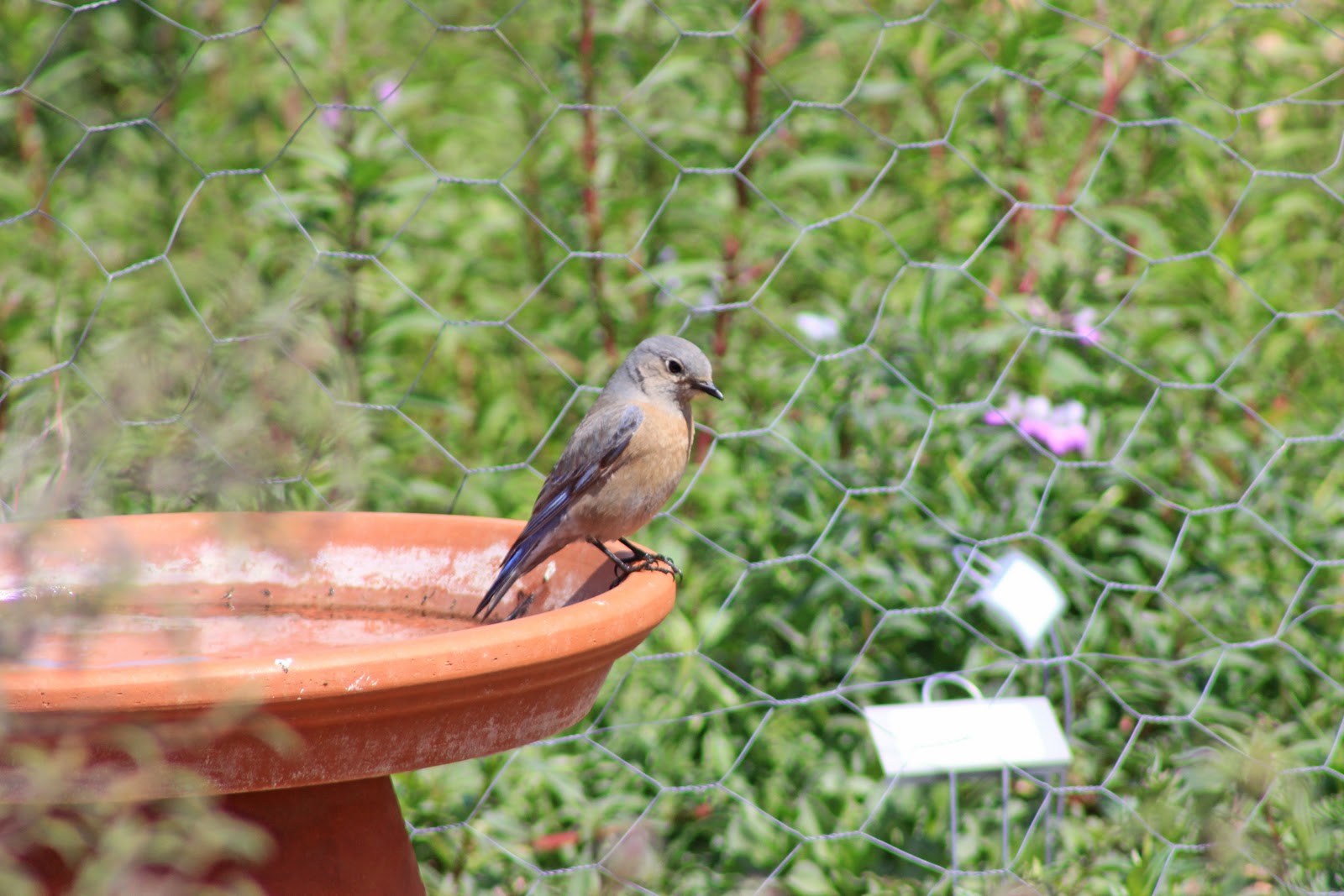
And here's the Mrs., with her 2 cents.

3/18/11 Perched on rebar.

What a cutie. I also put out some dried meal worms (from Armstrong Nursery) in a makeshift feeder nearby, hoping that it keep the bluebirds coming. They are still coming, but not for the worms. Maybe the dried stuff isn't as appealing as the live wiggly stuff.

3/18/11 A non-sequiter. I found this tiny, weathered old nest on the ground amongst some dried brush while weeding the trail off of the chaparral stand near the entry to the property. So delicate and only about 5" in diameter. I placed it in the inner branches of our now 8-ft. tall 'San Gabriel' Fremontodendron, just in case it can be reused by another birdie. 

Sunday, March 6, 2011

Chocolate Lilies, Shooting Stars & a Few Other Early Bloomers at the Santa Rosa Plateau

It was quite breezy this morning and much cooler than yesterday, but at least the sun was out, so we headed out to the Plateau this morning to see if there were any early blooms along the Vernal Pool trail. We stopped at the visitor center for trail info, and found out that the boardwalk over the main vernal pool was closed due to flooding from our most recent rain storm and the Vista Grande trail was also closed at the bridge. Kinda like groundhog day, as this is a repeat scenario from last year when the boardwalk was inundated and many of the footbridges on the Plateau badly damaged from heavy rains & flooding.


As for blooms, the most abundant were the Western Buttercups (Ranunculus occidentalis).  Along the Vernal Pool Trail, we saw some nice stands of Blue Dicks (Dichelostemma capitatum ssp. capitatum), Padres Shooting Stars (Dodecatheon clevelandii ssp. clevelandii), Bush Lupines (Lupinus excubitus ssp. hallii), a few California Poppies (Eschscholzia californica), and one Common Lomatium (Lomatium utriculatum). Along the Trans Preserve Trail, the Chocolate Lilies (Fritillaria biflora) are just starting to bloom, as well as Checker Bloom (Sidalcea malviflora ssp. sparsiflora), Blue-Eyed Grass (Sisyrinchium bellum), Johnny Jump-Up (Viola pedunculata), and Purple Sanicle (Sanicula bipinnatifida). In the oak understory along the Trans Preserve, Miner's Lettuce (Claytonia perfoliata), Wild Cucumber (Marah macrocarpus var. macrocarpus), Narrowleaf Milkweed (Asclepias fasciculatus), Common Bedstraw (Galium aparine), Poison Oak (Toxicodendron diversilobium), Soap Plant (Chlorogalum pomeridianum var. pomeridianum), and Sticky Cinquefoil (Potentilla glandulosa ssp. glandulosa) are all greening up.


 3/6/11 Vernal pool at the trailhead near the parking lot off Via Volcano. Lots of waterfowl, but will need to bring the spotting scope next time to see them better.

3/6/11 Main vernal pool.

3/6/11 Western Buttercup (Ranunculus occidentalis), Vernal Pool Trail. 

3/6/11 Main vernal pool, with Western Buttercups in the foreground.

3/6/11 The boardwalk over the main vernal pool looks quite askew.


Lots of debris along the sides of the boardwalk.

But the duckies aren't complaining. Main vernal pool.

3/6/11 Vernal Pool Trail.

3/6/11 Bush Lupine (Lupinus excubitus var. hallii). Vernal Pool Trail.

3/6/11 Padre's Shooting Star (Dodecatheon clevelandii ssp. clevelandii). A nice patch of these are blooming along the Vernal Pool Trail past the main vernal pool (heading towards the Adobes).

3/6/11 Padre's Shooting Star (Dodecatheon clevelandii ssp. clevelandii). Vernal Pool Trail.

3/6/11 An unusual white-flowered form of Padre's Shooting Star (Dodecatheon clevelandii ssp. clevelandii). Vernal Pool Trail.

3/6/11 Blue Dicks (Dichelostemma capitatum ssp. capitatum). Vernal Pool Trail.

3/6/11 Common Lomatium (Lomatium utriculatum). Vernal Pool Trail.

3/6/11 California Poppy (Eschscholzia californica). Vernal Pool Trail.

3/6/11 A Tiger Moth caterpillar. Every spring, these guys are EVERYWHERE along the trails - hard to avoid stepping on them! Trans Preserve Trail.

3/6/11 Chocolate Lily (Fritillaria biflora). Trans Preserve Trail.

3/6/11 Wild Cucumber (Marah macrocarpus var. macrocarpus) twining through some lovely (ahem) Poison Oak. Trans Preserve Trail.

3/6/11 View from Trans Preserve Trail.

3/6/11 Soap Plant (Chlorogalum pomeridianum var. pomeridianum). Trans Preserve Trail.

3/6/11 Some lush-looking Miner's Lettuce (Claytonia perfoliata). Pass the vinaigrette, please. Trans Preserve Trail.

3/6/11 A gnarly, but grand old oak tree (Coast Live Oak - Quercus agrifolia?). Trans Preserve Trail.

3/6/11 Narrowleaf Milkweed (Asclepias fasciculatus). Trans Preserve Trail.

3/6/11 Purple Sanicle (Sanicula bipinnatifida). Trans Preserve Trail.

3/6/11 Blue-Eyed Grass (Sisyrinchium bellum). Only a few of these in bloom along the Trans Preserve Trail.

3/6/11 Blue Dicks (Dichelostemma capitatum ssp. capitatum). Trans Preserve Trail.

3/6/11 Checker Bloom (Sidalcea malviflora ssp. sparsiflora). Trans Preserve Trail.

3/6/11 Dark-Eyed Junco (Junco hyemalis). Trans Preserve Trail.

3/6/11 Second to juvenile gulls, those drabbish, hyperactive microbirds high up in a tree are my favorite birds to ID (NOT!). 


Heck, I think I'm going to call this guy a Ruby-Crowned Kinglet (Regulus calendula). Minus the tell-tale flash of a ruby crown, it's a toss-up between that and a Hutton's Vireo (Vireo huttoni). But it looks like there's a black bar behind the second white wing bar, and the bill is on the thin side, so I say Ruby-Crowned Kinglet.

Sunday, February 27, 2011

Mission San Fernando Rey de Espana

It was very frosty and cold this morning after the last rain storm passed through our region on Friday-Saturday. Our overnight low was 28F, with wind chill bringing it down to 22F (well below normal for this time of year). The newly emerging leaves on all of our bougainvillea have turned black from the icy temps, Hana's outside water bowl and the birdbath were blocks of ice, and there was a layer of frost covering most of the ground. No snow in La Cresta (darnit!), but quite a lot of it came down in our local mountains . Other than the brisk temperatures, it was a gorgeous & sunny day today, so we drove up to Northridge to meet Gil's parents for dim sum, since we had missed our annual Christmas lunch with them back in December due to the heavy rains. It's not that they live in Northridge or that the San Fernando Valley is the Dim Sum capital of SoCal (I think that designation, hands down, goes to the San Gabriel Valley). But his parents live in Camarillo and we live in Murrieta, so Northridge is kind of a half-way point so that we don't have to drive 140 miles one way to meet up. And, since we were in the area, we had to stop by the San Fernando Mission on our drive home to check this one off of our list of the 21 California missions we have vowed to visit sometime in our lifetime. Six down, fifteen to go. 


2/27/11 Just love it. Only in California are Palm trees and snow-capped mountains like two peas in a pod. View of the San Gabriel Mountains from I-15N in Rancho Cucamonga.

2/27/11 Another view of the San Gabriels going eastbound on the 210 Fwy. at La Tuna Canyon Rd.

2/27/11 Snow at the La Tuna Canyon Rd. exit just off the 210. Lots of cars with spectators parked on the roadside. 

Now, onto the Mission! Mission San Fernando Rey de Espana, the 17th of Alta California's 21 missions along the El Camino Real, was founded by Fray Fermin Francisco de Lasuen on September 8, 1797. One of the most interesting parts of this mission is the "Convento" aka the "long building," which took about a dozen years to build (1810-1822) and is, according to Wiki, "the largest adobe building in California and the largest original building at any of the California missions." The adobe walls of the Convento are 4-feet thick and the most recognized feature is the long portico or corridor of 21 Roman arches.

2/27/11 Roman arches of the Convento (facing San Fernando Mission Rd.)

Convento (street view from San Fernando Mission Rd.)

2/27/11 What looks to be one of the original iron grilles on the Convento.


2/27/11 Bougainvillea in full bloom next to the Convento. 


A gorgeous chandelier in the Museum. Wish I had something like that hanging in our great room.

Museum.

Olive trees in the East Garden.

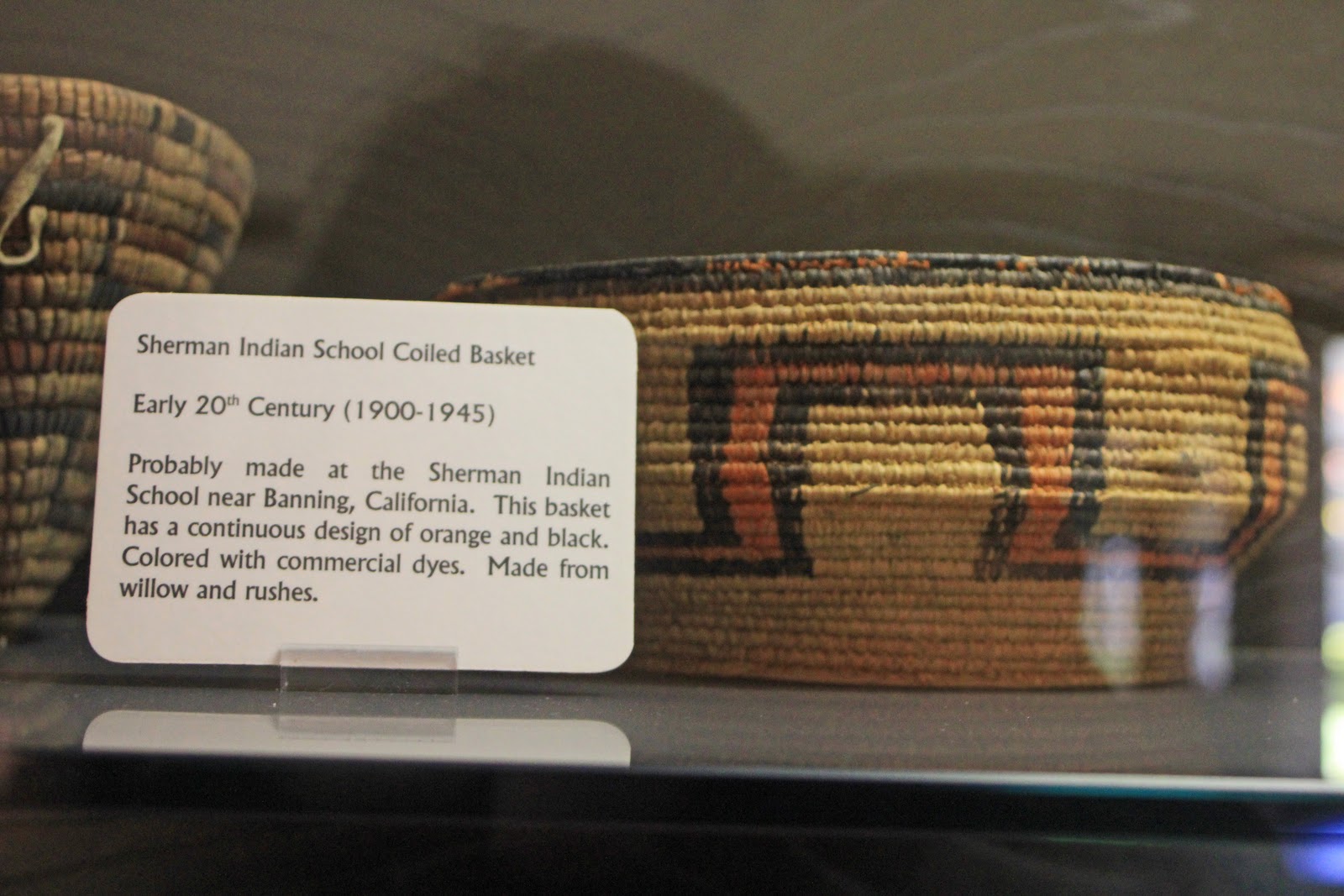
The museum houses a small but very nice collection of Native American basketry.


Another fab mission-style chandelier, in the Convento.

Displays in the Convento. 

La Sala. 
From the interpretive sign: "This heavy-beamed reception room is one of the largest and most elegant of any among the missions. Its large double doors mark the main entrance to the mission itself. Weary travelers received a warm and hearty welcome here and enjoyed the famous Franciscan hospitality for as long as they wished to stay. At a later date, this room served as a chapel when the original church was abandoned."

Historic library of the Bibliotheca Montereyensis-Angelorum Dioeceseos. The Mission is home to the Archival Center, a research facility that houses many of California's historical ecumenical documents dating from the Mission Period (ca. 1840). 

Some really fragile volumes in the collection.

These are just so cool. There were a series of posters on California's State Emblems on display in the Convento, all with a copyright date of 1958 by the Latin American Studio in Santa Barbara. Wonder if reprints are available. This one is of the State's 10th emblem, the Official State Fish: California Golden Trout.

The 6th State emblem: Official State Insect, the California Dogface Butterfly.

The 7th State emblem: Official State Bird, the California Quail.

The 3rd State emblem: Official State Flower, the California Poppy.

Exiting the Convento and heading towards the West Garden.


A tranquil waterfall and creek, almost hidden from view behind a bamboo thicket along the West Garden.

View of the Old Mission Church from the West Garden.

West Garden.

The Old Mission Church.
From the Mission brochure: "The fourth Mission church is an exact replica of the earlier edifice erected between 1804 and 1806....The interior furnishings were used in the earlier church...The 16th century gold-leafed reredos, a memorial to Eugenie Hannon, was installed in 1991. Pope John Paul II visited the church in September of 1987."


The original church was badly damaged in the 1971 San Fernando earthquake and had to be completely rebuilt. The reconstructed church was dedicated in 1974. 


"Our Lady of Hope" (replica of the 17th C. statue at the Basilica of Our Lady of Hope in Pontmain, France). Bob Hope Memorial Garden.


Bob Hope Memorial Garden.


A towering, majestic pine tree in the Bob Hope Memorial Garden.


Bob Hope's final resting place. We had no idea that he was buried here prior to our visit to the mission. A beautiful and fitting memorial garden for this beloved funnyman, humanitarian and patriot. 
For more on the dedication of the Bob Hope Memorial Garden on August 23, 2005, go to: http://www.catholicnews.com/data/stories/cns/0504809.htm 


Bob Hope memorabilia in the Mission Workshops wing.


Floss Silk Trees (Ceiba speciosa). East Garden.
Monsignor Francis Weber describes these trees as follows in his book The California Missions: "The floss-silk trees at San Fernando Mission, introduced by Clarese Kroll in 1982 from the Huntington Library, are often referred to as "the single most spectacular flowering trees in the United States." Silk trees are natives of southern Brazil and Argentina and are called samohu by local Indians. They are truly breathtaking in the late summer when their bare branches are covered completely with pink flowers and green fruit."


One of the El Camino Real bells at the mission. There's a perky little Black Phoebe on the sign. These guys were out in force today, flycatching from every conceivable perch in the East Garden.


East Garden. The flower-shaped fountain was copied from an original in Cordova, Spain.