I happen to like lizards, at least the ones that inhabit our area. Komodos & Monitors they are not...but they do eat insects, which I don't mind, especially if they are of the pesky kind. The more common denizens are the Granite Spiny Lizard (Sceloporus orcutti), Western Fence Lizard (Sceloporus occidentalis), and a yet-to-be identified species of Whiptail (Aspidoscelis spp.) They are all lively and full of personality, with some doing their rote pushups on the deck & retaining walls, while others spar in endlessly ritualistic paso dobles with encroachers & rivals. While I think that all lizards have an inherent beauty - their patterns & colors can be quite fetching - my all-time favorite has to be the Coast Horned Lizard, aka "Horny Toads." Although their roundish flat bodies may emote toad, these itty bitty guys, ranging from around 2 1/2" to 6", are all lizard and just so damned cute. They range in most of California west of the deserts and typically inhabit open areas with loose, sandy soil, from the lowlands all the up to 8,000 ft. Their diet consists mainly of harvester ants. In the summer of 2001, before the house was built, I saw my first horned lizard along a dirt road cutting through the chaparral stand on the property. Hadn't seen one since, until just a few weeks ago when I spied an adorable little tyke scuttling along the driveway. Here he is, all 3 inches of him, the cutest of them all:





4/10/11 Coast Horned Lizard (Phrynosoma coronatum).


After the rain & frost tapered off last month, it's been mostly mild & sunny. However, we had some really blustery Santa Ana winds this weekend, so I had to restake a few plants, including the El Dorado Gold Fremontia (Flannelbushes are easily uprooted by wind) and all the felled inflorescences of Showy Penstemon. Other than that, the plants in the garden are doing swimmingly. Here are some views of the (mostly) natives in bloom right now.

4/17/11 Twinberry (Lonicera involucrata var. ledebourii). This one is growing under a persimmon tree in the kitchen herb garden, a bit shaded and also kept watered during our summer heat.

4/17/11 Western Vervain (Verbena lasiostachys).
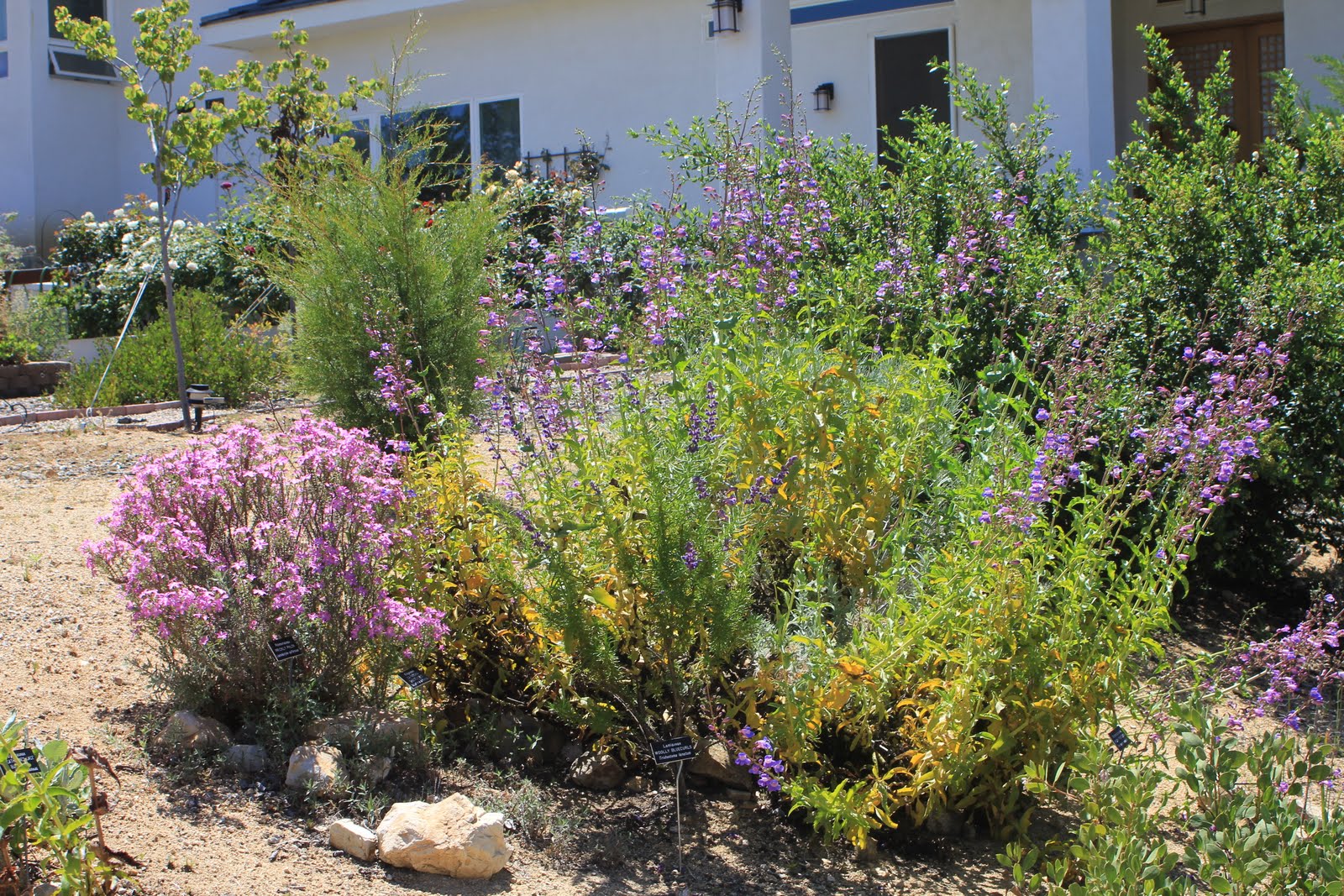
4/16/11 Prickly Phlox (Leptodactylon californicum) to the left, and Showy Penstemon (Penstemon spectabilis) to the right.

4/16/11 "Powerline Pink" Hummingbird Sage (Salvia spathacea), along the fenceline under a Mexican Elderberry (Sambucus mexicana).

4/16/11 Western Wallflower (Erysimum capitatum).

4/16/11 Calico Monkeyflower (Mimulus pictus).

4/16/11 Prickly Phlox (Leptodactylon californicum), with a few Showy Penstemon (Penstemon spectabilis) peeking through. This shrub is about 3 years old, and stunning in full bloom. After the first year, I stopped watering it altogether - very drought tolerant. After the spring bloom, prickly phlox will go somewhat dormant and become nondescript until the next rains green it up again.

4/16/11 "Mountain Haze" Ceanothus.

4/16/11 Western Redbud (Cercis occidentalis).

4/16/11 'Sunset Strain' Lewisia (Lewisia cotyledon), growing in a terra cotta pot.

'San Diego Sunrise' Monkeyflower (Diplacus clevelandii x puniceus).

5/1/11 'Santa Ana Cardinal' Coral Bells (Heuchera hybrid).

5/1/11 Bigleaf Lupine (Lupinus polyphyllus). Native to moist, boggy areas in N. California. I've seen these growing streamside along Soda Creek in the Sonora Pass (Eastern Sierras), but the flowers were a light purple, not pink like these. This one is planted in a bed dedicated to mountain meadow/riparian plants that like their feet wet, including Western Spiraea (Spiraea douglasii), Scarlet Monkeflower (Mimulus cardinalis), California Coneflower (Rudbeckia californica), Western Blue Flag (Iris missouriensis), Slender Cinquefoil (Potentilla gracilis), Sierra Penstemon (Penstemon heterodoxus), and Fireweed (Epilobium angustifolium). Hope it survives our SoCal heat come summer...

5/1/11 Mexican Elderberry (Sambucus mexicana) with Desert Wild Grape (Vitis girdiana) growing along the fence. Gil did his ninja master arborist thing on the Elderberry this past winter and removed all the suckers & lower branches to keep it looking tidy with one main trunk & a nice open crown.

5/1/11 Cow Parsnip (Heracleum lanatum) and Parish's Stream Lupine (Lupinus latifolius parishii) in a planter on the north side of the house. Regular water and a partly shady spot is a must for these guys here in SW Riverside County.

5/1/11 Bush Anemone (Carpinteria californica). This one's about 4' tall and finally flowering after 2 years. The blooms are lightly fragrant.

5/1/11 Eaton's Penstemon (Penstemon eatonii).

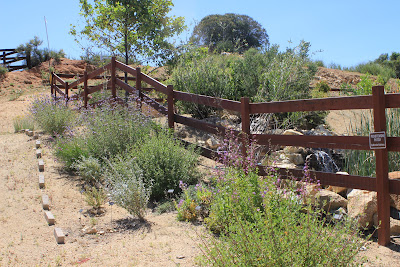
5/1/11 I've dubbed this area along the fence line "Penstemon Patch" and "Sage Hill," respectively (all planted with Cal Natives). Starting from the bottom up: Showy Penstemon (Penstemon spectabilis), Eaton's Penstemon (Penstemon eatonii), and Scarlet Buglar (Penstemon centranthifolius); next, 'Figueroa,' 'Pt. Sal,' & 'Tilden Prostrate' Purple Sages (Salvia leucophylla), San Diego Sage (S. munzii), Brandegee's Sage (S. brandegeei), 'Winnifred Gilman' Sage (S. clevelandii), 'Alpine' Cleveland Sage (S. clevelandii), White Sage (S. apiana), and Salvia hybrids 'Celestial Blue,' 'Pozo Blue,' & 'Gracias.' At the very top is a large stand of Golden Yarrow (Eriophyllum confertiflorum), which are native to the site. A couple winters ago, I transplanted about a dozen of these from the adjacent chaparral, and they are now well-established & reseeding like crazy. Their bright yellow flowers contrast very nicely with the purple blooms of the sages.
 5/1/11 Pink Fairyduster (Calliandria eriophylla). This desert native struggled for about 3 years (hates our cold, wettish, foggy winters here on the Plateau), but seems to be perking up finally.
 5/1/11 Next to Desert Purple Sage (Salvia dorrii), Rose Sage or Mountain Desert Sage (S. pachyphylla) is one of my fav sages. This selection is called 'Blue Flame' and comes from High Country Gardens nursery in New Mexico. The flowers bracts are huge and an electric blue-purple!
 5/1/11 Elegant Clarkia (Clarkia unguiculata) in full bloom in the native wildflower bed.
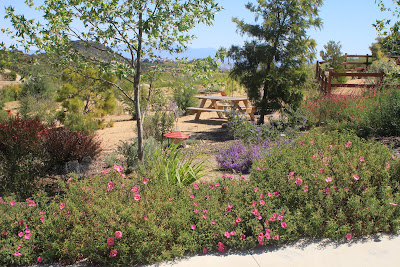 5/1/11 Assorted Rockroses (Cistus) with Penstemon 'Margarita BOP' in the backdrop.
 5/1/11 Another shot of the driveway, with clumps of Deergrass (Muhlenbergia rigens) between the newly leafing Sycamores. 'Pink Butterflies' Gaura (Gaura lindheimeri) provide some colorful contrast on the right.
 5/1/11 Natives mingling with drought-tolerant non-natives along the driveway: Wandflower (Gaura lindheimeri), 'Arizona Sun' Blanketflower (Gaillardia), 'De La Mina' Cedros Island Verbena, 'Dark Star' Ceanothus, and "Allen Chickering' Sage (S. clevelandii). There are also 4 young 'Morning Cloud' Chitalpas (a cross between Catalpa and our native Desert Willow Chilopsis linearis), which I hope will grow into nice floriferous shade trees in a few years.
 5/1/11 Wallace's Pitcher Sage (Lepechinia fragrans). Love, love, love the smell of this plant when you brush against it (if you're crazy about chaparral, you'll understand).
 5/1/11 Southern California Snowberry (Symphoricarpos mollis). A plant of SoCal's higher elevations, this one appears to be doing fine down here at 2,000 ft.


And I know I've posted a gazillion pictures of these sparrows before, but they are real posers:

4/17/11 White Crowned Sparrow (Z0notrichia leucophrys).

4/16/11 Lark Sparrow (Chondestes grammacus).